
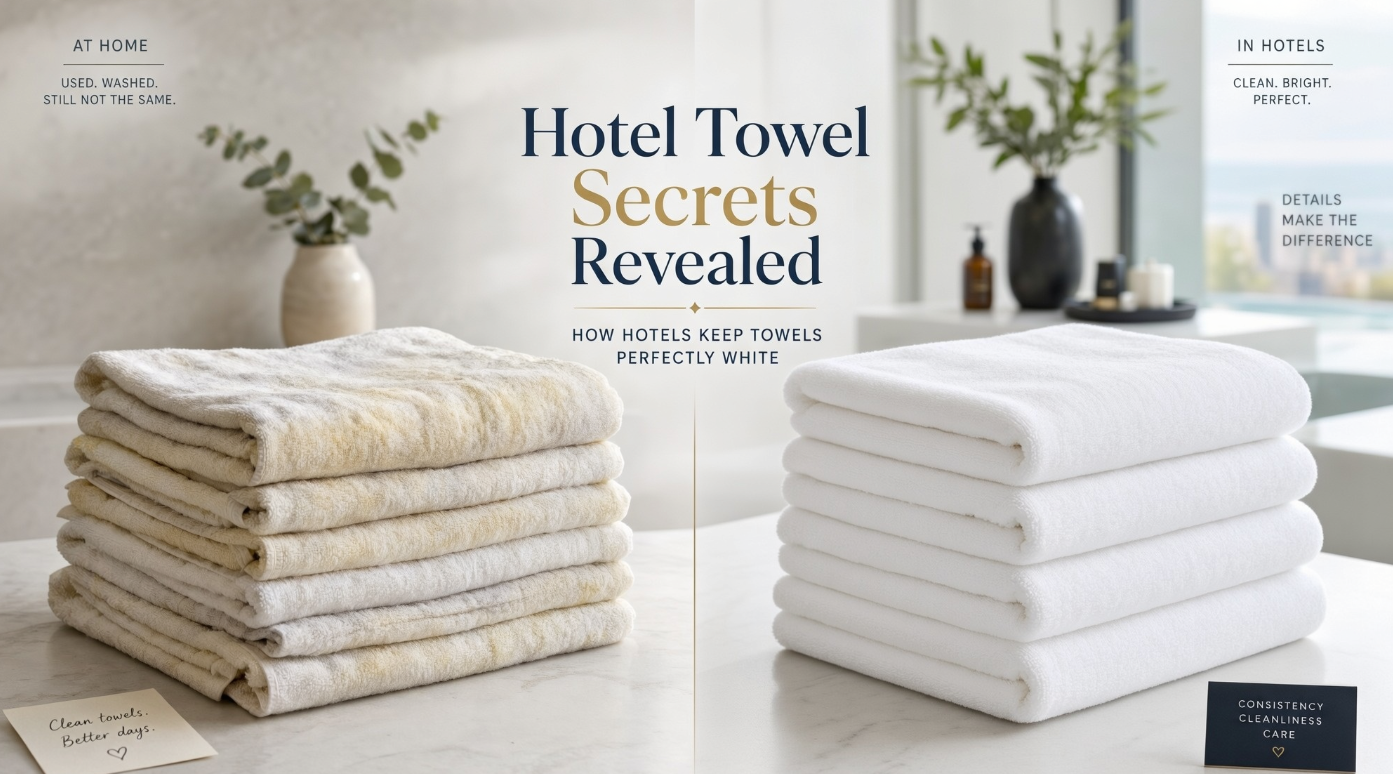
Hotels wash white towels using industrial-grade washing machines with water temperatures between 160-180°F, professional detergents with optical brighteners, and oxygen-based bleach. The process includes pre-treatment for stains, hot water washing cycles, proper chemical ratios (typically 1-2 ounces of detergent per pound of laundry), and high-temperature drying that kills bacteria while maintaining that crisp, bright-white appearance you love.
Why Hotels Choose White Towels in the First Place
You’ve probably noticed that nearly every hotel uses white towels, and there’s solid reasoning behind this universal choice.
White towels allow hotels to use powerful bleaching agents and high-temperature washing without worrying about color fading. This means they can achieve the highest level of sanitization—something that’s absolutely critical in the hospitality industry where cleanliness directly impacts guest satisfaction and health safety.
Here’s the interesting part: white towels also serve as a visual quality indicator. Guests can immediately see that towels are clean, free from stains, and properly sanitized. According to hospitality industry studies, approximately 87% of guests associate white linens with cleanliness and luxury.
[IMAGE SUGGESTION: Stacks of pristine white hotel towels arranged on shelving in a luxury hotel spa]
The practical benefits extend beyond perception. Hotels typically replace their towel inventory every 2-3 years, and white towels are easier to bleach, restore, and maintain consistently across thousands of washing cycles. When a colored towel fades, it looks worn out. When a white towel maintains its brightness, it continues looking premium.
Additionally, white towels simplify inventory management. Hotels don’t need to sort by color, which speeds up laundry operations and reduces the risk of color bleeding accidents that could ruin entire loads.
Read: Bath Sheet vs Bath Towel :Which Is Right for You?
The Commercial Laundry Process Explained
The hotel towel washing process is significantly more sophisticated than what you do at home. Let me walk you through what actually happens from the moment you drop that towel on the bathroom floor.
Step 1: Collection and Sorting
Housekeeping collects used towels and separates them into categories:
- Lightly soiled (single-use towels)
- Moderately soiled (regular bath towels)
- Heavily soiled (gym towels, pool towels, stained items)
This sorting determines the wash intensity and chemical treatment each batch receives.
Step 2: Pre-Treatment
Heavily stained towels go through pre-treatment before entering the main wash cycle. Hotels use enzyme-based pre-spotters that break down protein-based stains (makeup, blood, body oils) and oxidizing agents for dye-based stains like hair color or wine.
Step 3: The Main Wash Cycle
Professional hotel laundries follow a specific wash formula:
- Pre-wash: Cold water rinse to remove loose dirt and debris
- Main wash: Hot water (160-180°F) with alkaline detergents
- Bleach cycle: Oxygen bleach or diluted chlorine bleach added
- Rinse cycles: Multiple rinses to remove all chemical residue
- Softener/sour cycle: Neutralizes pH and adds softness
The entire process takes 25-40 minutes per load, depending on soil level.
Step 4: Extraction and Drying
Industrial extractors spin at extremely high speeds (300-400 G-force compared to 100-150 in home machines), removing up to 95% of moisture. This dramatically reduces drying time and energy costs.
Towels then go into large-capacity dryers at temperatures around 140-160°F until completely dry.
Pro Tip: Hotels never overload their machines. Commercial washers are filled to only 80% capacity to ensure proper agitation and cleaning. This is one reason hotel towels come out cleaner than home-washed ones.
[IMAGE SUGGESTION: Commercial hotel laundry facility showing large industrial washing machines and folding stations]
What Chemicals and Detergents Do Hotels Use?
This is where the magic happens. Hotels don’t use the same Tide or Gain you buy at Target. They use specialized commercial formulations designed for institutional laundering.
Professional-Grade Detergents
Commercial laundry detergents contain higher concentrations of:
- Surfactants (30-40% vs. 15-20% in consumer products)
- Alkaline builders that soften water and boost cleaning power
- Enzymes (protease, amylase, lipase) that digest specific stain types
- Anti-redeposition agents that prevent dirt from settling back onto fabric
Popular commercial brands include Ecolab, Diversey, and Christeyns—names you won’t find in retail stores.
Bleaching Agents
Hotels typically use two types of bleach:
Oxygen bleach (hydrogen peroxide-based):
- Gentler on fabrics
- Color-safe
- Effective at lower temperatures
- Better for the environment
Chlorine bleach (sodium hypochlorite):
- Maximum whitening power
- Superior sanitization (kills 99.9% of bacteria and viruses)
- More aggressive on fabric fibers
- Used in diluted concentrations (200-500 ppm)
According to laundry industry experts, luxury hotels are increasingly switching to oxygen bleach systems combined with advanced chemistry to extend towel lifespan while maintaining brightness.
Optical Brighteners: The Secret Weapon
Here’s something most people don’t know: hotels use optical brighteners (also called fluorescent whitening agents) that make white towels appear brighter than they actually are.
These molecules absorb invisible UV light and re-emit it as visible blue light, counteracting the yellowish tinge that naturally occurs in white fabric. It’s essentially a controlled optical illusion that makes towels look whiter-than-white.
Water Conditioning Chemicals
Hard water is the enemy of white towels. Hotels in areas with hard water use:
- Water softeners (ion exchange systems)
- Sequestering agents (chelating chemicals that bind calcium and magnesium)
- pH adjusters to maintain optimal washing conditions (pH 10-11 for main wash)
These prevent mineral deposits that cause yellowing and dingy appearance.
[IMAGE SUGGESTION: Chart comparing chemical composition of commercial vs. consumer laundry detergents]
The Secret Behind Hotel Towel Brightness
You might be wondering why your white towels at home never quite match that hotel-quality brightness. The answer involves several factors working together.
Consistent water temperature is crucial. Hotels maintain precise water temperatures throughout the entire wash cycle. Research from the American Hotel & Lodging Association shows that washing at 160°F or higher is 300% more effective at removing oils and organic matter compared to 105°F washing.
The chemical timing matters immensely. Professional laundry systems use automated chemical injection that adds specific chemicals at exact moments in the wash cycle. Bleach added too early can neutralize detergents; added too late won’t have enough contact time.
Hotels also use multiple rinse cycles (typically 3-4 compared to 1-2 at home). This ensures complete removal of detergent residue, which can cause yellowing and dinginess over time. Each rinse uses fresh water, not recycled water.
Here’s a lesser-known fact: the drying process contributes significantly to brightness. High-heat drying actually helps “set” the optical brighteners into the fabric, and UV exposure from some commercial dryers provides additional whitening effects.
Pro Tip: The texture you feel on hotel towels comes from avoiding fabric softener in every wash. Hotels typically use softener only every 3-5 washes to maintain absorbency while preventing the waxy buildup that dulls brightness.
How Temperature Makes All the Difference
Temperature isn’t just about cleaning—it’s the foundation of the entire hotel laundry sanitization process.
Why Hotels Use Extremely Hot Water
The hospitality industry follows strict sanitation standards. The Occupational Safety and Health Administration (OSHA) and various state health departments recommend washing temperatures of at least 160°F for healthcare and hospitality linens.
At this temperature:
- Most bacteria and viruses are killed within 10 minutes
- Body oils and proteins break down and release from fabric
- Detergents work at peak efficiency
- Stains become easier to remove
Luxury hotels often push temperatures even higher, to 180-200°F, especially for gym towels and spa linens where hygiene is paramount.
The Temperature Cycle Breakdown
A typical hotel wash cycle uses varied temperatures strategically:
- Pre-wash: 70-90°F (prevents protein stains from setting)
- Main wash: 160-180°F (peak cleaning temperature)
- Bleach addition: 140-160°F (optimal bleach activation)
- Rinse cycles: Progressively cooler (130°F down to 90°F)
- Final rinse: Cold water (closes fabric fibers)
This thermal gradient approach maximizes cleaning while minimizing thermal shock to fabrics.
Energy Efficiency Considerations
You might think this uses enormous amounts of energy—and traditionally, it did. However, modern hotel laundries have become remarkably efficient.
Many hotels now use heat recovery systems that capture thermal energy from dryer exhaust and hot water discharge to preheat incoming cold water. According to the Commercial Laundry Efficiency Initiative, this can reduce energy costs by 30-40%.
Some cutting-edge hotels are even experimenting with ozone laundering systems that allow effective sanitization at lower temperatures (90-110°F) by injecting ozone gas into the wash water.
[IMAGE SUGGESTION: Infographic showing temperature zones throughout a commercial hotel wash cycle]
Industrial Equipment vs. Home Washing Machines
The equipment difference between hotel laundries and your home setup is staggering, and it explains much of the quality gap.
Capacity and Efficiency
Industrial washing machines process 125-400 pounds per load compared to your home machine’s 12-18 pound capacity. This isn’t just about volume—larger machines allow better water circulation and mechanical action.
The extract speed (final spin cycle) in commercial machines reaches 300-400 G-force, compared to 100-150 in residential machines. This means towels emerge with minimal moisture, reducing drying time by 40-50%.
Programmable Chemistry Systems
Here’s where it gets really sophisticated. Industrial laundry systems use computer-controlled chemical injection that automatically dispenses precise amounts of:
- Detergent
- Bleach
- Softener
- Sour (pH neutralizer)
- Starch (for linens)
These systems track water hardness, load size, and soil level to adjust chemical ratios in real-time. A typical system might have 6-10 different chemical products that get injected at specific times during the wash cycle.
Water Volume and Pressure
Commercial machines use 40-60 gallons per cycle at water pressures of 40-80 PSI. This high-volume, high-pressure approach provides superior flushing action that removes deeply embedded soil particles.
Modern tunnel washers (used by large hotel chains) create a continuous washing process where towels move through different chambers, each performing a specific function. It’s like a car wash for towels.
Durability and Maintenance
Industrial machines are built to run 14-18 hours daily, processing thousands of pounds weekly. They feature:
- Stainless steel drums and outer shells
- Heavy-duty bearings rated for millions of cycles
- Programmable controls with hundreds of custom cycles
- Built-in diagnostics and maintenance alerts
A commercial washer costs $15,000-$50,000 but lasts 15-20 years with proper maintenance. Your home machine costs $500-$1,500 and lasts 8-12 years.
Expert Insight: “The mechanical action in commercial machines is fundamentally different,” explains Sarah Chen, a hospitality laundry consultant with 20 years of experience. “The combination of high water volume, precise temperature control, and vigorous agitation creates cleaning results that simply can’t be replicated at home, regardless of which detergent you use.”
[IMAGE SUGGESTION: Side-by-side comparison photo of industrial hotel washing machine next to standard home washing machine]
How Often Hotels Actually Wash Their Towels
Let’s address the elephant in the room: do hotels wash towels after every guest?
Industry Standards
The overwhelming majority of reputable hotels wash all towels after each guest checkout, regardless of how long the guest stayed or how the towels appear. This is both a hygiene requirement and a brand standards issue.
During a guest’s stay, here’s the typical protocol:
- Towels on the floor = housekeeping washes them
- Towels hung up = guest keeps them (environmental programs)
- Guest request = housekeeping replaces them regardless
According to a 2022 American Hotel & Lodging Educational Institute survey, 94% of hotels have daily linen exchange programs, though many now offer opt-out options for environmental reasons.
The Wash Frequency Reality
Beyond guest use, hotels also re-wash towels that:
- Sit unused in inventory for more than 30 days
- Get exposed to dust during storage
- Show any signs of odor or discoloration
- Come back from spa or pool areas (always washed after single use)
High-end hotels like Four Seasons and Ritz-Carlton have even more stringent protocols, sometimes washing inventory towels every 2-3 weeks whether they’ve been used or not.
Lifespan and Replacement Cycles
Even with industrial-grade washing, hotel towels don’t last forever. Most properties replace towels based on:
Usage-based replacement:
- Luxury hotels: Every 1-2 years
- Mid-range hotels: Every 2-3 years
- Budget hotels: Every 3-5 years
Condition-based replacement:
- Visible staining that doesn’t wash out
- Thinning fabric (measured by weight loss of more than 10%)
- Rough texture from fiber breakdown
- Loss of absorbency
The average hotel towel undergoes 200-300 wash cycles before retirement. Compare that to home towels, which typically see 50-100 washes over their lifetime.
Pro Tip: When hotels retire towels, they don’t throw them away. Many donate them to animal shelters, use them as cleaning rags, or sell them to towel recycling companies that repurpose the cotton fibers.
Can You Replicate Hotel Towel Quality at Home?
You absolutely can get closer to hotel-quality results, though you’ll never achieve 100% parity due to equipment limitations. Here’s how to maximize your results.
Step-by-Step Home Washing Process
1. Use the hottest water your towels can handle
Check care labels, but most white cotton towels can handle 140-160°F. Run your hot water tap before starting to ensure the machine gets truly hot water.
2. Don’t overload your machine
Fill your washer only 2/3 full. Towels need room to agitate properly. For a standard machine, wash only 4-6 bath towels at a time.
3. Use the right amount of detergent
More isn’t better. Use half the recommended amount of a high-quality detergent. Excess detergent builds up and causes dinginess.
4. Add oxygen bleach or white vinegar
- Oxygen bleach (OxiClean): 1/2 cup per load for whitening
- White vinegar: 1 cup in the fabric softener dispenser to remove buildup
5. Skip the fabric softener most washes
Fabric softener reduces absorbency. Use it only every 5-6 washes if you want softer towels.
6. Use an extra rinse cycle
This removes all detergent residue that causes yellowing.
7. Dry completely on high heat
Hotels never use low-heat drying. High heat sanitizes and fluffs fibers.
Products That Actually Work
Based on testing and industry recommendations:
Detergents:
- Tide Ultra (powder formula works better than liquid)
- Persil ProClean
- Kirkland Signature (Costco brand)
Boosters:
- OxiClean White Revive (oxygen bleach with optical brighteners)
- Clorox 2 for Colors (works great on whites too)
- Borax (1/2 cup per load for water softening)
Occasional deep cleaning:
Mix together in the washer:
- 1/2 cup baking soda
- 1/2 cup Borax
- Regular detergent
- Hot water wash
This strips built-up residue and restores brightness.
What You Should Never Do
Avoid these common mistakes that make white towels dingy:
❌ Washing in cold or warm water (doesn’t remove body oils)
❌ Using too much detergent (creates buildup)
❌ Using liquid fabric softener every wash (coats fibers)
❌ Overloading the machine (prevents proper cleaning)
❌ Mixing whites with colors (even light colors can transfer dyes)
❌ Leaving wet towels in the washer (causes mildew smell)
[IMAGE SUGGESTION: Before and after photos showing dingy home towels transformed using hotel-inspired washing techniques]
The Realistic Expectation
Even following all these steps, your home towels won’t quite match hotel quality because:
- Your water temperature caps around 130-140°F vs. 160-180°F
- Home machines lack commercial-grade mechanical action
- You don’t have access to industrial chemical formulations
- Your water pressure and volume are lower
But you can easily achieve 70-80% of hotel quality, which is a massive improvement over typical home results.
Expert Secret: Professional laundry managers suggest washing white towels separately every 3-4 uses with a “strip wash”—hot water, no detergent, just 1/4 cup Borax and 1/4 cup washing soda. This removes invisible buildup that prevents your regular washes from working effectively.
Common Mistakes to Avoid
Let me save you from the frustrating mistakes that ruin white towels over time.
1. Using chlorine bleach in every wash
While hotels use bleach regularly, they use diluted concentrations with professional equipment. Home use of chlorine bleach every wash breaks down cotton fibers, causing yellowing and weakness. Limit chlorine bleach to once every 4-5 washes, and use oxygen bleach the rest of the time.
2. Washing towels with other items
Mixing towels with sheets, clothes, or other items prevents proper cleaning. Towels need aggressive agitation in an uncrowded environment. The friction between towels actually helps clean them—something you lose when mixing loads.
3. Not cleaning your washing machine
A dirty washing machine transfers grime, odors, and bacteria to your “clean” towels. Run a monthly cleaning cycle with:
- 2 cups white vinegar (for first cycle)
- 1/2 cup baking soda (for second cycle)
- Wipe door seals and gaskets
4. Air-drying white towels
Line-drying seems eco-friendly, but it leaves towels stiff and can cause yellowing from sun exposure. Hotels always machine-dry because high heat provides sanitization and fluffiness while setting optical brighteners.
5. Storing towels while still slightly damp
Even 5% moisture remaining creates the perfect environment for mildew and musty odors. If your towels smell funky even after washing, this is usually the culprit. Ensure complete drying before folding and storing.
6. Using water that’s too soft
While hard water causes problems, overly soft water doesn’t rinse detergent effectively. If you have a water softener, you may need to reduce detergent by 25-50% to prevent buildup.
7. Buying low-quality white towels
Not all white towels are created equal. Hotel-quality towels feature:
- 600-900 GSM (grams per square meter) weight
- 100% combed or ring-spun cotton
- Double-stitched hems
- No decorative trims that trap dirt
Cheap towels (under 400 GSM) won’t hold up to hotel-style washing and won’t achieve the same brightness.
[IMAGE SUGGESTION: Infographic showing common towel-washing mistakes with red X marks and correct methods with green checkmarks]
FAQ
Q: Do hotels use bleach on white towels every time?
A: Not always. Most hotels use oxygen bleach with every wash for sanitization and brightness, but reserve chlorine bleach for periodic deep cleaning or heavily stained items. High-end hotels increasingly use hydrogen peroxide-based systems that achieve similar whitening without the harsh effects of chlorine, extending towel lifespan while maintaining that crisp appearance. The exact frequency depends on the hotel’s standards and water quality.
Q: What temperature do hotels wash towels at?
A: Hotels typically wash towels at 160-180°F (71-82°C) during the main wash cycle. This high temperature kills bacteria, viruses, and dust mites while dissolving body oils and proteins that cause staining. Some luxury properties push temperatures to 190-200°F for spa and gym towels. This is significantly hotter than most home water heaters, which max out around 120-140°F.
Q: Why do hotel towels stay white while mine turn gray or yellow?
A: Hotel towels maintain brightness through a combination of very hot water (160°F+), commercial detergents with optical brighteners, proper chemical ratios, multiple rinse cycles, and never overloading machines. Home towels typically turn dingy from washing in cooler water, using too much detergent that builds up over time, washing with colored items, or using fabric softener that coats fibers and traps dirt.
Q: How many times can you wash a white towel before it wears out?
A: Hotel towels undergo 200-300 commercial wash cycles before replacement (typically 1-3 years). Home towels can last 100-150 washes or 2-5 years depending on washing practices and quality. Higher-quality towels with 600+ GSM weight and combed cotton fibers last longer. Signs it’s time to replace include thinning fabric, loss of absorbency, persistent staining, or rough texture despite proper washing.
Q: Do hotels really wash towels between every guest?
A: Yes, reputable hotels wash all towels after each guest checks out, regardless of appearance or length of stay. This is an industry standard for hygiene and brand reputation. During a guest’s stay, most hotels follow environmental programs where towels left hanging stay (if the guest prefers), while towels on the floor signal the need for washing. Budget properties might occasionally have lapses, but major chains maintain strict protocols with tracking systems.
Q: What chemicals do hotels use to make towels smell fresh?
A: Hotels use commercial laundry fragrances designed for institutional use, typically added during the final rinse cycle. These are much more concentrated and longer-lasting than consumer fabric softeners. Popular scents include “Fresh Linen,” “Clean Cotton,” and proprietary hotel signature scents. Many luxury hotels also use ozone injection systems that naturally deodorize without fragrances, or essential oil-based scenting systems for a more natural approach.
Q: Can I buy the same towels that hotels use?
A: Absolutely. Many hotels source from wholesale suppliers that also sell to the public. Look for commercial towel suppliers like 1888 Mills, Standard Textile, or Turkish Towel Company. The key specifications are 600-900 GSM weight, 100% ring-spun or combed cotton, and commercial-grade construction. Some hotel chains like Marriott and Westin even sell their signature towels directly through retail partnerships.
Q: How do hotels keep towels soft without fabric softener?
A: Hotels maintain softness primarily through proper drying techniques—high heat tumble drying creates airflow that fluffs fibers naturally. Commercial extractors also remove more water before drying, reducing the time towels spend in the dryer, which prevents fiber breakdown. When hotels do use softener, it’s every 3-5 washes at most, and they use commercial formulations that don’t coat fibers like consumer products do.
Key Takeaways
- Temperature is critical: Hotels wash white towels at 160-180°F to sanitize and remove oils effectively—much hotter than typical home washing
- Chemical precision matters: Commercial detergents contain 30-40% surfactants (vs. 15-20% in consumer products) plus optical brighteners that make white appear brighter
- Never overload machines: Hotels fill washers to only 80% capacity to ensure proper agitation and cleaning
- Multiple rinses prevent dinginess: 3-4 rinse cycles remove all detergent residue that causes yellowing over time
- Oxygen bleach is your friend: Use it regularly instead of relying on harsh chlorine bleach every wash
- High-heat drying is essential: Machine drying on high heat sanitizes, fluffs fibers, and sets optical brighteners—never air-dry white towels
- Quality towels make a difference: Look for 600+ GSM weight and 100% combed cotton for hotel-like durability
- Strip-wash periodically: Every 3-4 uses, wash with just Borax and washing soda to remove invisible buildup
- Separate your whites: Washing towels alone allows better agitation and prevents dye transfer
- Replace strategically: After 200-300 washes or when absorbency decreases noticeably
[IMAGE SUGGESTION: Summary infographic with icons representing each key takeaway point]
Conclusion
The brilliant white, fluffy towels you experience in hotels aren’t magic—they’re the result of industrial-grade equipment, commercial chemistry, and precise processes that most of us can’t fully replicate at home. But now you understand the science behind it.
Hotels maintain those pristine white towels through a combination of extremely hot water (160-180°F), professional detergents with optical brighteners, oxygen-based bleaching systems, and equipment that provides superior mechanical action and water extraction. The process is designed not just for cleaning, but for sanitization and longevity across hundreds of wash cycles.
Here’s the good news: you can absolutely improve your white towel situation at home. By washing in the hottest water your towels can handle, using oxygen bleach regularly, never overloading your machine, skipping fabric softener most of the time, and ensuring complete high-heat drying, you’ll see dramatic improvements.
Start with one change this week—maybe it’s buying actual hotel-quality towels with 600+ GSM weight, or simply washing your current towels in smaller loads with hotter water. Small adjustments compound over time, and within a few weeks, you’ll notice your bathroom towels looking fresher, feeling fluffier, and staying whiter longer.
Remember, those ultra-bright hotel towels have gone through the same rigorous process dozens of times. Give your towels the same consistent care, and you’ll be amazed at the transformation.
Related Topics:
- How to Remove Yellow Stains from White Towels Permanently
- Best Commercial-Grade Towels for Home Use: A Buyer’s Guide
- The Complete Guide to Stripping Laundry: Remove Years of Buildup
- Why Do My Towels Smell Musty Even After Washing? Solutions That Work
- Hotel Laundry Secrets: How to Wash Bed Sheets Like a 5-Star Hotel
- Oxygen Bleach vs. Chlorine Bleach: Which Is Better for White Laundry?